April 26, 2026
Wait, There Is an Artist Behind Every Card?
It took me a few days of asking AI about Pokemon cards before I realized the answer keeps including a name. Each card was illustrated by a real person. Comparing two cards side by side made the whole artist angle come alive.
So I am very AI-forward. I use Claude and ChatGPT all the time. As I have been getting into Pokemon, my workflow has been: take a photo of a card, upload it, ask “Hey, what is this thing? What is it worth? Tell me everything.” And honestly, the AI is great at it. It pulls the name, the set, the rarity, the type, all of it.
But the answer that stopped me in my tracks was when it told me, “this card was illustrated by Mitsuhiro Arita.”
Wait. Illustrator? There is a person?
Of course there is a person. Someone got paid to design that card. Someone made it look beautiful. It is digital artwork by a real human, and that artwork is the whole reason the card looks the way it looks. That had honestly never crossed my mind.
A real name in the fine print
Once I knew to look, I found the credit. It is printed in the bottom left of every card in tiny text. So tiny that I had to zoom in with a magnifying glass to read it the first time. But once I saw it, I started seeing it on every card.
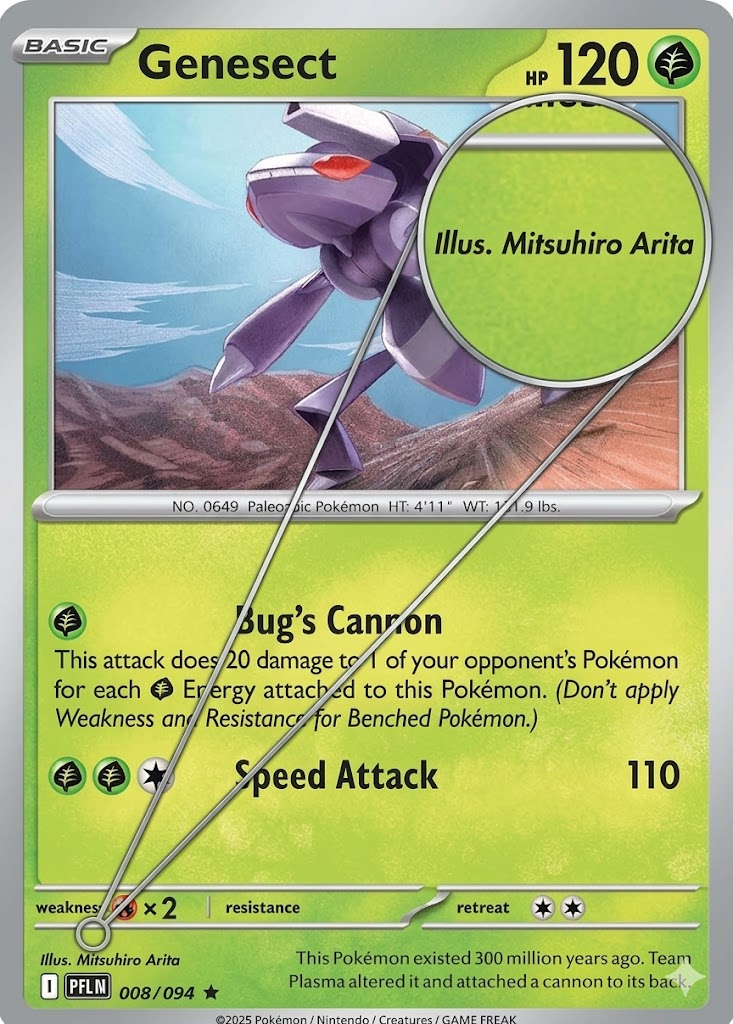
Quick context on this one. My kids opened a pack and I lifted the Genesect right out of it. So this card walked into my collection sideways, through them. Different doorway from how I picked up my first card, but the same shelf.
Two cards, two illustrators
Here is the move that helped this click. I grabbed a second card and put them side by side.
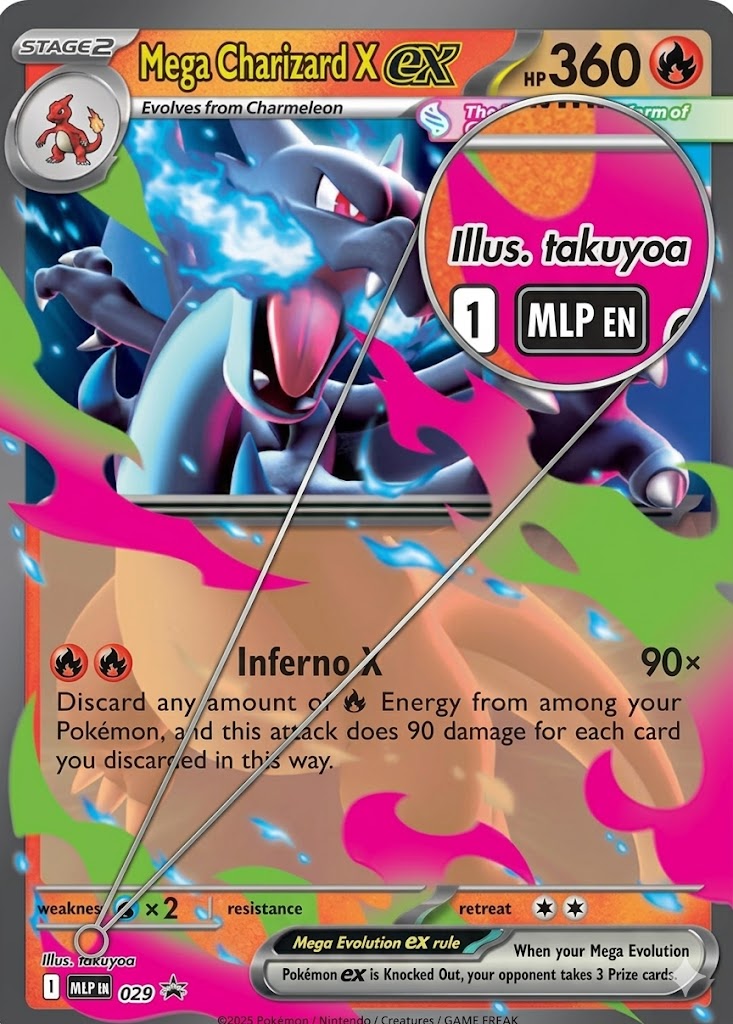
A double-first worth saying out loud. This Mega Charizard X ex is also the very first Pokemon card I ever bought. Six bucks. I picked Charizard because it was the only Pokemon name I already recognized, so it felt like a safe place to start. And takuyoa is the first artist I ever heard of in the whole Pokemon world. Right? Once a name registers, you cannot unregister it. So this card pulls double duty: my first card, and the first artist whose name landed. takuyoa earned a permanent spot in my collector’s journey just by being on it.
The Genesect by Arita is grounded and painterly, a little bit cinematic landscape. The takuyoa Charizard is dark and neon, almost glitchy, like a music video frame. Same franchise, same trading-card frame, two completely different visual voices.
Right? Once you compare the two, the artist’s hand jumps out. You stop seeing “a Pokemon card” and you start seeing the artist behind it.
A whole new collecting angle
This opens up something I did not even know existed. You can collect by artist. If a particular illustrator has a style you love, you can chase down other cards they did. Mitsuhiro Arita has hundreds of cards going back to 1996. takuyoa is doing some of the bold modern work on the newer Mega Evolution sets. Either way, that is a sub-collection inside the bigger collection.
The next time you pull a card and love it, the question is no longer just “what Pokemon is this?” It is also “who drew it? What else have they drawn? Is there a card by the same artist I could pair with this one?”
That is super cool to me.
Compare and contrast is how I learn anything
Pulling two cards next to each other taught me more than studying any one card on its own. There is a real principle in there. One example tells you what something is. Two examples tell you what it is, what it is not, and what the variation looks like.
I am not a Pokemon expert. I am barely a few days in. But this is a learning move that works in any domain. One Pokemon card on its own is useful. Two cards by two different illustrators next to each other? That is when you start seeing patterns. That is when the learning sticks.
So that is what I am taking away from this one. There is an artist behind every card. The credit is in the fine print, bottom left. And the fastest way to start appreciating the artwork is to grab two cards and look at them side by side.
One thread, pulled. Onto the next one.

