April 26, 2026
What Do Those Pokemon Numbers Actually Mean?
Charizard is #006. Genesect is #649. Pecharunt is #1025. The number next to every Pokemon's name is a little time stamp, and once it clicked for me the whole franchise felt mappable.
So I am brand new to Pokemon. I started flipping through cards and clicking around online and noticed every Pokemon has a little number next to its name. For example, Charizard is #006, Pikachu is #025, and Genesect is #649. Three completely different numbers. What gives?
Okay. So I went and figured it out. Here is what I learned, written down for the next person who is staring at their first Pokemon and wondering the same thing.
The number is the National Pokédex number
Every Pokemon has a unique ID called its National Pokédex number (or “National Dex” if you want to sound like you have been doing this longer than five minutes). It is assigned in the order the Pokemon was first introduced, going all the way back to the original Red and Blue games in 1996.
Bulbasaur was the very first Pokemon ever revealed. He is #001. The Gen 1 starter line goes:
- #001 Bulbasaur
- #002 Ivysaur
- #003 Venusaur
- #004 Charmander
- #005 Charmeleon
- #006 Charizard
So Charizard being #006 is not random. He is literally the 6th Pokemon ever introduced. That is super cool when you think about it. The number is a little time stamp.
1025 is the current grand total
Right now, there are exactly 1025 Pokemon in the National Pokédex. That is everything from Gen 1 (Kanto, 1996) through Gen 9 (Paldea, the Scarlet and Violet games plus their DLCs).
The most recent one, Pokemon #1025, is Pecharunt. He was added in early 2024.
So when you see a Pokemon with #006 next to its name, you are looking at a Pokemon that has been around almost as long as the franchise itself. When you see #1025, you are looking at the newest one in the dex.
Each generation has its own slice of the number line
Here is the part that really helped me. Each Pokemon generation got assigned a contiguous block of numbers. Once I saw the breakdown, the world started to feel a lot more mappable:
| Generation | Region | Range | Count |
|---|---|---|---|
| 1 | Kanto | 001 to 151 | 151 |
| 2 | Johto | 152 to 251 | 100 |
| 3 | Hoenn | 252 to 386 | 135 |
| 4 | Sinnoh | 387 to 493 | 107 |
| 5 | Unova | 494 to 649 | 156 |
| 6 | Kalos | 650 to 721 | 72 |
| 7 | Alola | 722 to 809 | 88 |
| 8 | Galar | 810 to 905 | 96 |
| 9 | Paldea | 906 to 1025 | 120 |
So Genesect at #649 puts him at the very end of Gen 5 (Unova). Right? He is the last Pokemon that game added before Gen 6 took over. Now if I see a number anywhere (a card, a wiki, this site), I can glance at this table and know roughly which era and which game it came from.
That is a quality-of-life upgrade for a beginner like me.
The number is hiding on the actual cards
Okay, here is the part I think is super cool. Once you know what these numbers are, you start seeing them everywhere. They are printed right on the actual Pokemon cards. Just very, very small.
So check this out. Here is a Genesect card. I went looking for the Pokédex number and circled it in red because honestly you almost need a magnifying glass to find it.
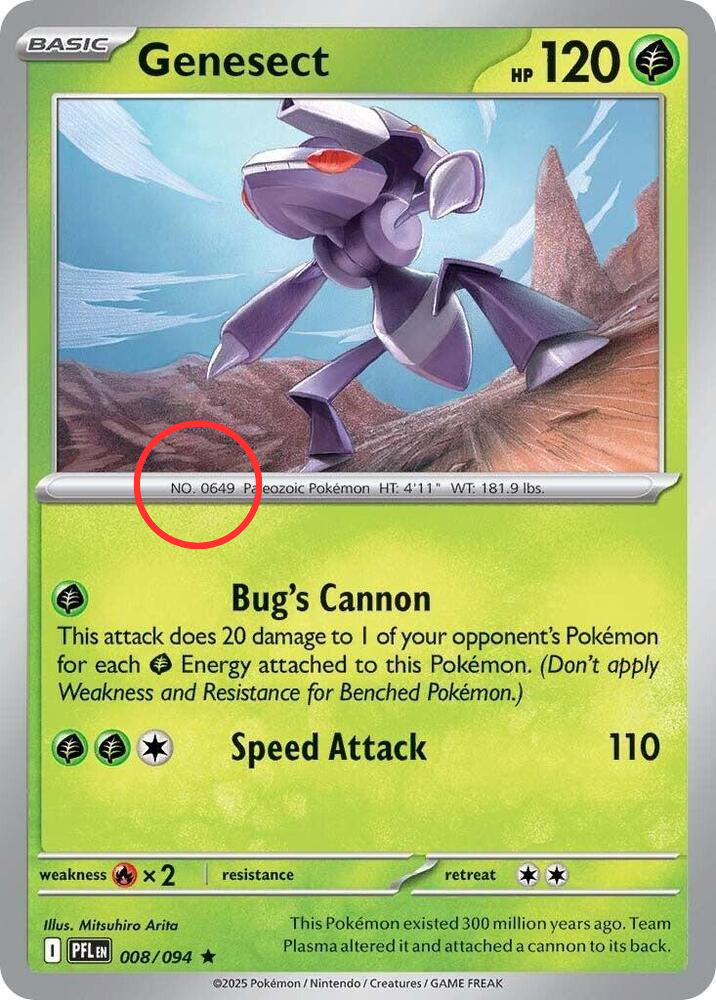
This is the part that surprised me. The connection between the National Dex and the cards in your hand is right there in plain print. Just tiny. So a kid pulls a pack and flips a card over, and has no idea that the 649 is basically an address: Pokemon number 649, last entry in Generation 5. But once you know to look, it is right there on every card.
A small caveat: regional Pokédexes
One little wrinkle. Each game also has its own regional Pokédex which numbers the Pokemon based on the order you encounter them in that specific region’s game. So in the Kalos Pokédex, Charizard is not #006. He has a different number based on where he shows up in X and Y.
I am not chasing those down right now. The National Dex is the one used as the universal reference everywhere. When you see #006 on a card, on a wiki, on this site, that is the National Dex number.
So what
I am not a Pokemon expert. I have been at this for a few days. But this one little fact made the whole franchise feel less random.
Here is the move I am going to keep using: when something feels overwhelming, find one little detail and ask, “what is this for?” That tiny number turned into a generation map, which turned into a release timeline, which turned into a sense of how big the world actually is.
One thread, pulled. Onto the next one.


